The First Enclosure
The capture of the maternal body did not begin with Nestlé

The capture of the maternal body did not begin with Nestlé. It did not begin with the Church. It is older than Christ, older than Rome, older than scripture. This is the full chain.
I ended “Mother’s Milk” with Henri Nestlé, 1867, Vevey, Switzerland. Farine Lactée. The industrial enclosure of the breast. I called it one of the most well-documented cases of corporate enclosure in modern history, and it is.
But I was starting the clock too late. The industrial enclosure was the last enclosure. Before the factory came the Church. Before the Church came the philosophers. Before the philosophers came the priests. Before the priests came the first culture that looked at a woman nursing her child and saw not a relationship but a resource — not a commons but a commodity waiting to be managed.
The enclosure of mother’s milk is not a modern event. It is a civilizational project, and it has been running for at least four thousand years.
I. The Sacred Capture: Egypt and the Divine Nurse
The earliest known theological enclosure of the lactating breast belongs to ancient Egypt.
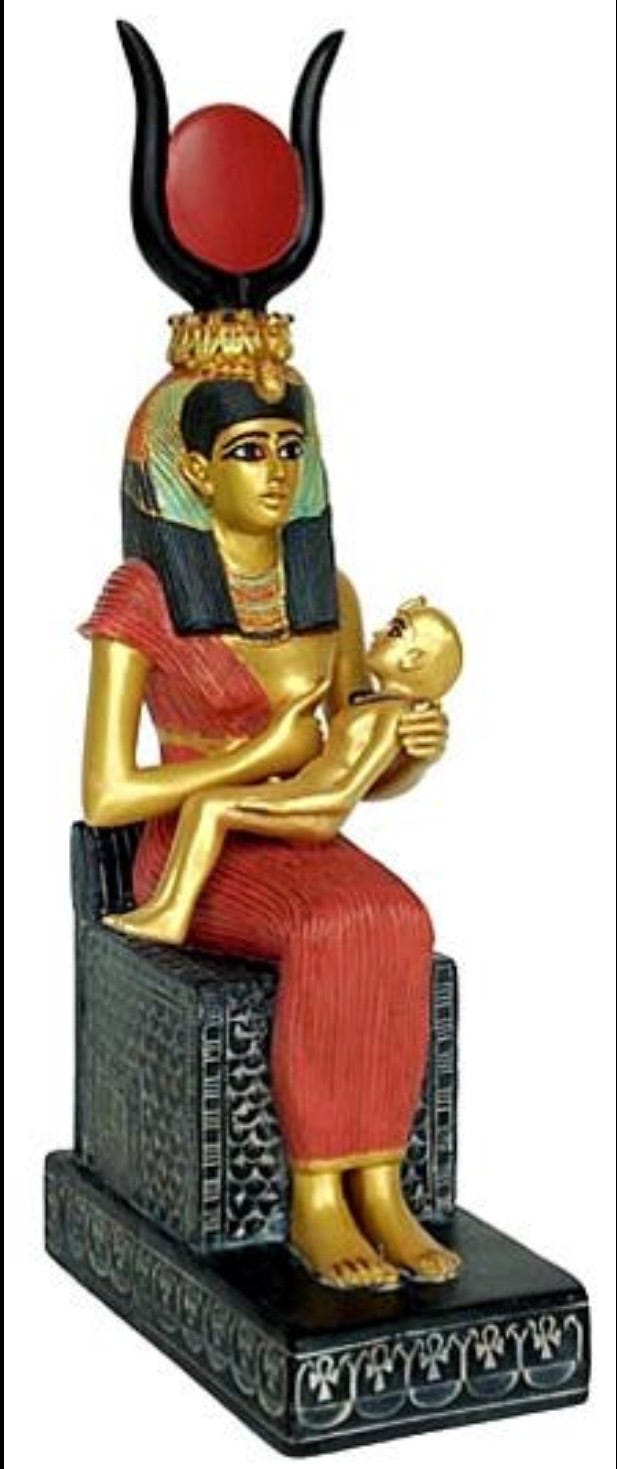
Isis nursing Horus is one of the oldest and most enduring devotional images in human history. It appears in tomb paintings, temple reliefs, and bronze figurines from at least the second millennium BCE and persists through the Ptolemaic period into the early centuries of the Common Era. The image is not decorative. It is doctrinal. Isis does not nurse Horus because she is his mother. She nurses him because nursing is the mechanism through which divine power is transmitted — the milk carries sovereignty. When the pharaoh was depicted suckling from Isis or Hathor, it was not a metaphor for nourishment. It was a claim of legitimacy. The milk made the king.
Hathor — cow goddess, sky goddess, goddess of fertility and motherhood — was depicted nursing the pharaoh directly, sometimes in bovine form. Her milk was the substance of divine right. The Ebers Papyrus, dated to approximately 1550 BCE, contains prescriptions for breast milk as medicine — not as infant food, but as a therapeutic substance to be collected, assessed, and administered according to specific criteria. Which breast. Which mother. Which conditions. The milk was already being abstracted from the nursing relationship and evaluated as a product.
This is the template. Once the milk means something beyond the mother-child relationship — once it carries divine authority, political legitimacy, or medical value defined by someone other than the mother — the enclosure has begun. The substance still flows from the breast. But the meaning flows from the institution.
II. The Purity Apparatus: Levitical Law and the Contaminated Mother
The Hebrew Bible formalized what Egypt had implied: the maternal body is ritually dangerous and requires institutional management.
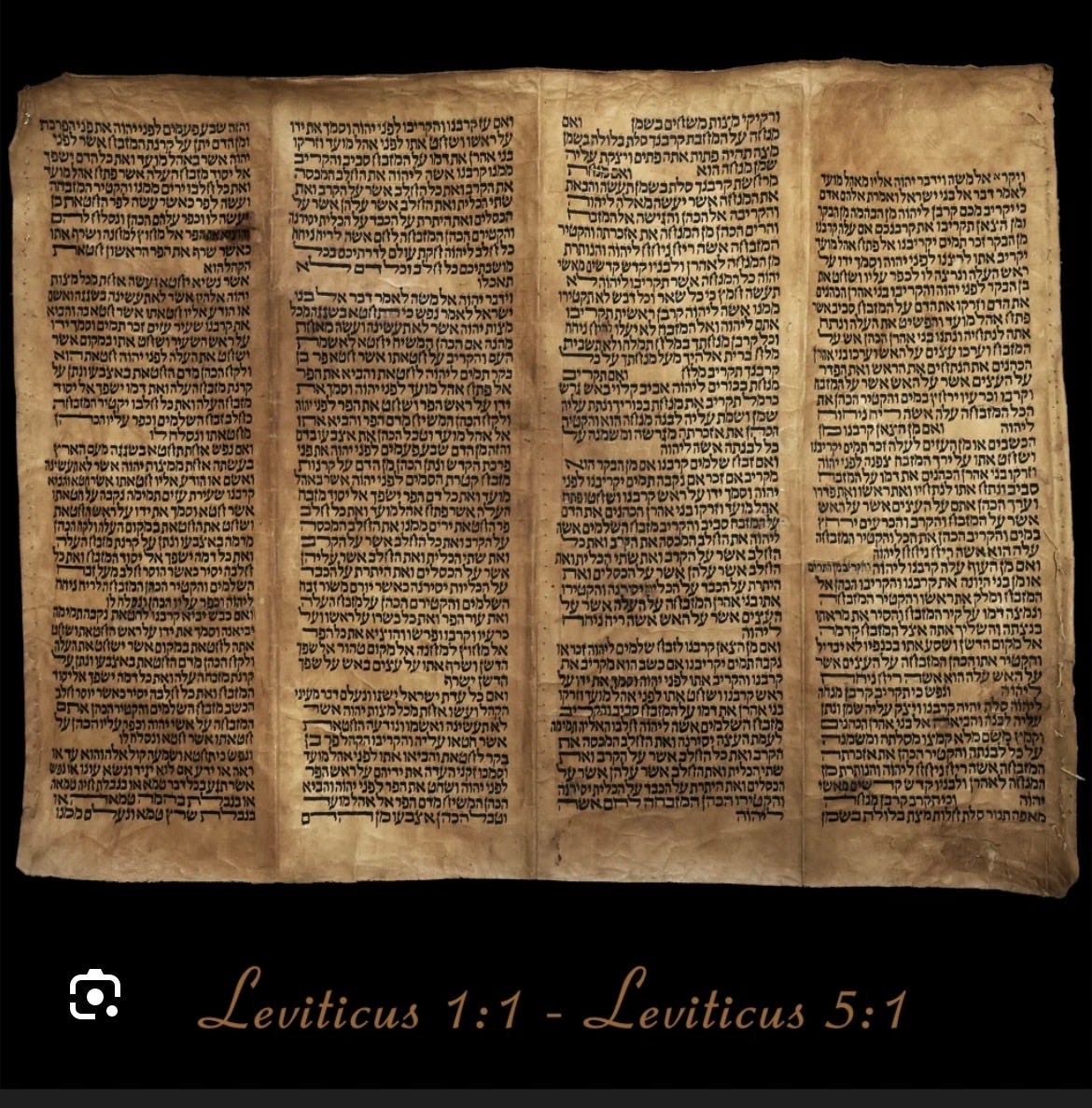
Leviticus 12 is explicit. A woman who gives birth to a son is ritually impure — tame — for seven days, then must wait an additional thirty-three days of “blood purification” before she may touch any sacred thing or enter the sanctuary. Total: forty days. A woman who gives birth to a daughter is impure for fourteen days, with sixty-six additional days of purification. Total: eighty days. At the end of this period, she must bring a burnt offering and a sin offering to the priest. The priest makes atonement for her. Then she is clean.
Read that again. The act of giving birth requires atonement. The mother has not sinned in any conventional sense. She has done the thing that continues the species, the community, the covenant. And the first institutional response is to declare her body polluted and to require priestly mediation before she can re-enter sacred space.
The postpartum body — the bleeding body, the lactating body, the body that has just performed the most fundamental act of biological commons — is declared unfit for the presence of God. Only the priest can restore her. Only the institution can make her clean.
This is not the same as the Egyptian capture, but it is structurally continuous. In Egypt, the milk is captured upward — it becomes divine substance, kingly legitimacy. In Levitical law, the body is captured downward — it becomes a site of contamination that only institutional authority can remediate. Both moves accomplish the same thing: the maternal body no longer belongs to the mother. Its status — sacred or polluted, powerful or dangerous — is determined by the institution.
The asymmetry of the purification periods tells you something the text does not say aloud. A female child makes the mother twice as impure as a male child. The body that produces another body capable of future maternity is doubly contaminated. The capacity to bear — not sin, not transgression, but biological capacity — is what the institution is managing. The purity apparatus is a technology for controlling reproductive bodies, and it scales with the reproductive potential of the offspring.
III. The Philosophical Subordination: Greece and the Mother as Raw Material
If Levitical law enclosed the maternal body through purity, Greek philosophy enclosed it through ontology. It told the mother that her body was not really creating anything at all.
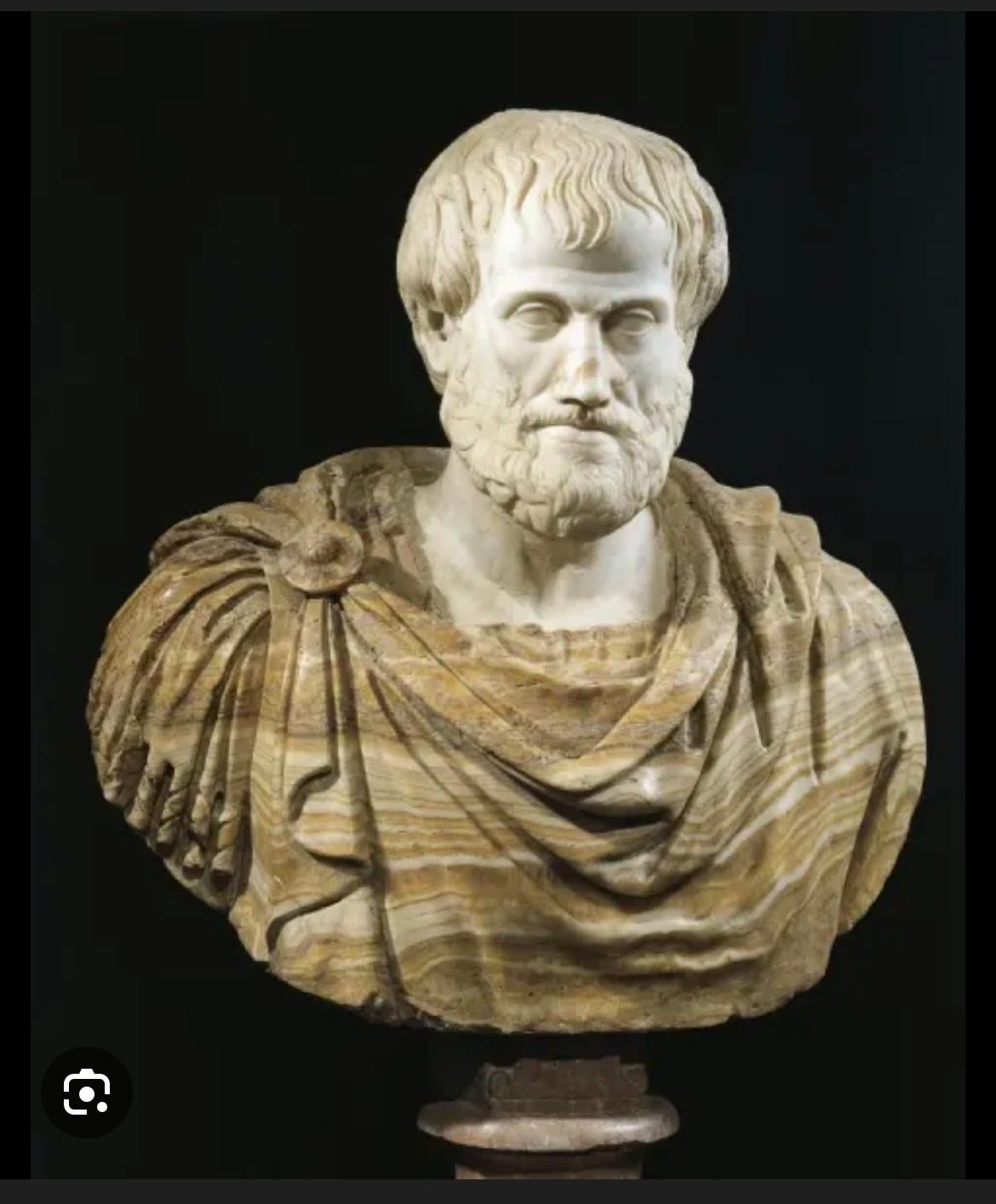
Aristotle’s Generation of Animals, written in the fourth century BCE, provides the framework. The male contributes the form — the soul, the organizing principle, the essence of the new being. The female contributes the matter — the raw material, the substrate, the passive stuff upon which form acts. The mother does not generate. She receives. She is the field; the father is the seed. Her body is necessary but secondary, instrumental but not creative.
Breast milk, in Aristotelian biology, is “concocted blood” — menstrual blood that has been processed by the heat of the female body into a different substance. It is not a creation of the mother. It is a transformation of a base material. The language matters: concoction implies that the female body is a processing plant, not a source. The value is in the input (blood) and the output (milk). The body in between is machinery.
This framework did not stay in Athens. It traveled through Roman medicine, through the early Church Fathers, through Aquinas, and into the theological architecture of Western Christianity. When the medieval Church defined the Virgin Mary’s role in the Incarnation, it drew on Aristotelian biology: Mary provided the matter; God provided the form. Her body was the vessel. Her contribution was passive receptivity. The philosophical subordination of the maternal body underwrote the theological subordination of the maternal body, and both served the same function — ensuring that the creative authority, the generative power, the meaning of what the mother produced belonged to someone other than her.
Hippocrates and later Soranus of Ephesus extended this into medical practice. The Hippocratic corpus contains instructions for evaluating breast milk — its color, consistency, smell, and taste. Soranus, writing in the second century CE, produced detailed criteria for selecting wet nurses: age, temperament, breast shape, milk quality. The good nurse was Greek, not barbarian. She was neither too fat nor too thin. She was emotionally controlled. Her milk was white, sweet, and of medium consistency.
The mother’s body — any mother’s body — was now subject to expert evaluation. The authority to determine whether a woman’s milk was adequate had been transferred from the mother to the physician. The milk flowed from the breast, but its adequacy was determined by the man with the text.
IV. The Extraction Infrastructure: Rome and the Institutionalization of Wet Nursing
Rome industrialized what Greece had rationalized.
Wet nursing was not a Roman invention — it appears in the Code of Hammurabi, c. 1754 BCE, which includes provisions regulating the wet nurse’s conduct and compensation, including the death penalty if a nurse substituted a different child for the one in her care. But Rome built the institutional infrastructure that made wet nursing a normalized, class-stratified, large-scale extraction of one woman’s bodily labor for another woman’s benefit.
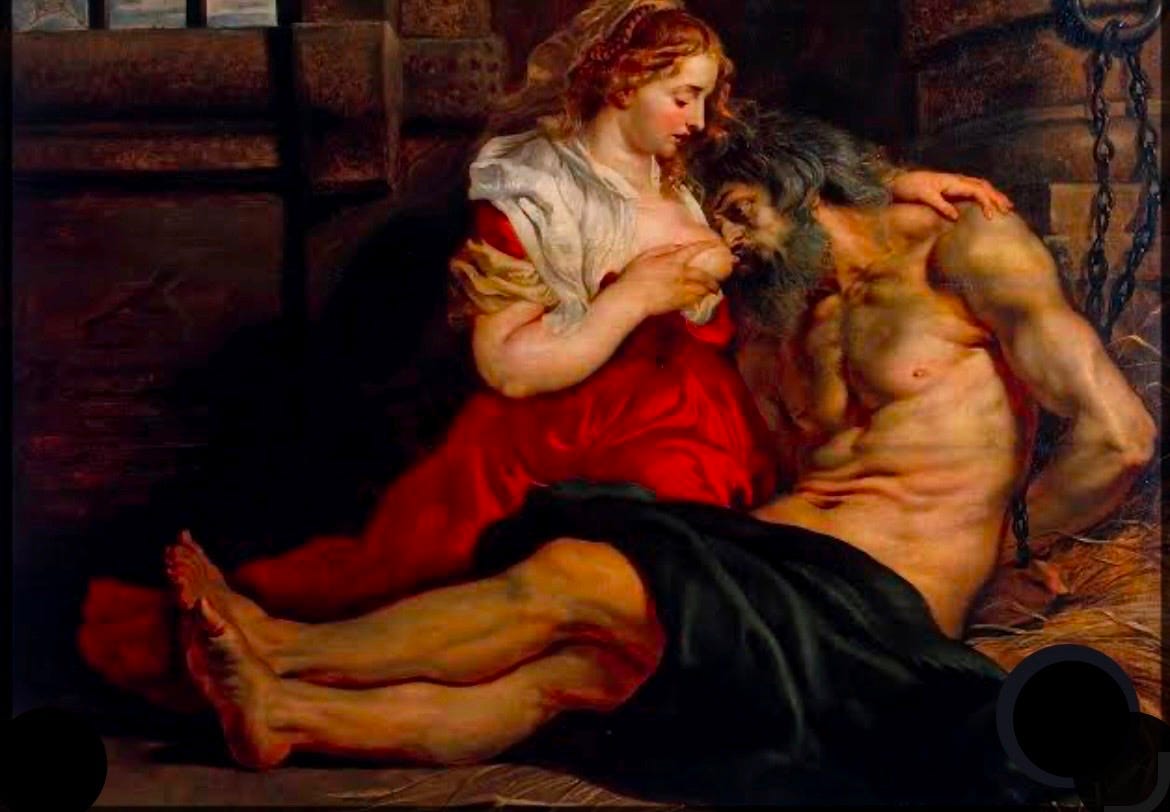
By the imperial period, wet nursing among the Roman elite was not an exception but an expectation. Soranus’s Gynecology provided the medical justification: the mother’s milk might be compromised by the exertion of delivery, by emotional disturbance, by resumption of sexual activity. Better to employ a nurse whose body could be managed, whose diet could be controlled, whose behavior could be monitored. The wet nurse was, functionally, a supervised production unit. Her body was contracted for its output.
Slave women nursed free children. This is the fact that sits at the center and that the classical sources mostly do not dwell on. The milk of enslaved women — women whose bodies were already legally property — flowed to the children of their owners. The most intimate substance of the maternal body was extracted under conditions of total coercion, and the culture that practiced this did not consider it extraction. It was simply what those bodies were for.
When I say that the enclosure of the breast is a civilizational project, this is what I mean. By the time Christianity arrives, the infrastructure is already built. The sacred capture (Egypt), the purity apparatus (Leviticus), the philosophical subordination (Aristotle), and the extraction economy (Rome) are all operational. Christianity does not start from zero. It inherits all four systems — and it welds them into a single totalizing framework with unprecedented institutional reach.
V. The Totalizing Synthesis: Christianity and the Scaling Engine
The Roman Catholic Church did not invent the enclosure of the maternal body. What it did was worse. It completed it.
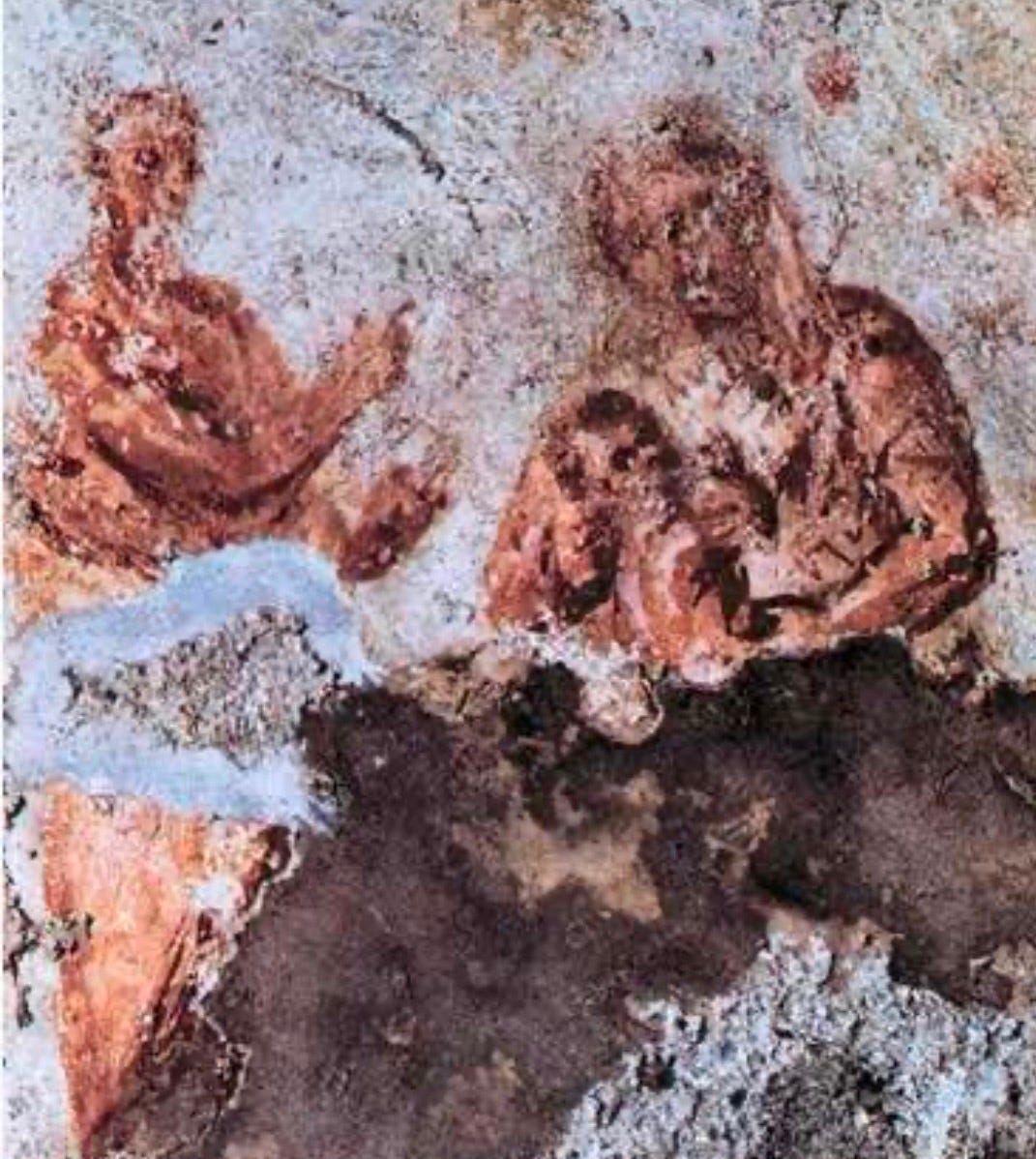
Christianity inherited the Egyptian template of the sacred nurse and produced the Madonna Lactans — the Virgin Mary breastfeeding the infant Christ, one of the most widespread devotional images in the history of Western art. It appears in the Catacomb of Priscilla in Rome, dated to the second or third century. The iconographic continuity from Isis-Horus to Mary-Christ has been traced by scholars almost point for point. The posture, the exposed breast, the divine infant — the Church adopted an image that was already thousands of years old and re-consecrated it under new management.
Christianity inherited the Levitical purity apparatus and institutionalized it as doctrine. The Feast of the Purification of the Virgin — Candlemas, February 2 — celebrates Mary’s compliance with the Levitical postpartum purification requirement. The mother of God herself is depicted submitting to the forty-day purity law. The message to every other mother was not subtle: if Mary required purification after childbirth, how much more do you? The Church adopted the “churching” of women — a ritual performed forty days after delivery in which the new mother was blessed and readmitted to the community — that persisted in Catholic practice into the twentieth century. My mother’s generation knew this ritual. The maternal body remained, in institutional terms, a site that required remediation.
Christianity inherited the Aristotelian biology of passive female matter and active male form, and Aquinas built it into the doctrinal structure of the faith. The Virgin provided the matter for the Incarnation. God provided the form. Mary’s body was necessary but instrumental — a vessel, not a co-creator. Her holiness was defined not by what she did but by what she lacked: sexual desire, bodily autonomy, independent will. She was fiat mihi — “let it be done unto me.” The model of female sanctity was total receptivity to institutional purpose.
And Christianity inherited and expanded the Roman extraction economy of wet nursing, blessing it with theological architecture that made it morally invisible as extraction. If the milk belongs to God — if it is grace, if it is mercy, if its meaning is institutional rather than relational — then it does not particularly matter which body produces it. The substance is fungible. What matters is the status of the recipient, not the condition of the source.
But Christianity added something that none of its predecessors had achieved: totality.
Egypt sacralized the milk but did not regulate every mother’s body. Levitical law managed the postpartum body but operated within a tribal and temple system of limited geographic reach. Aristotle’s biology was influential but remained the property of educated elites. Rome industrialized wet nursing but did not build a moral cosmology around it.
The Church did all of it. Simultaneously. Across all of Europe. For more than a thousand years. It controlled the image (Madonna Lactans), the substance (the Virgin’s Milk as relic), the ritual (churching), the moral framework (purity and submission), and the economic arrangement (wet nursing as blessed service). There was no dimension of the maternal body that the Church did not claim authority over — from its theological meaning to its ritual status to its economic deployment to its visual representation.
And then, when the image became inconvenient, the Church enclosed that too.
VI. The Relic and the Erasure
The Virgin’s Milk — Lac Virginis — became one of the most widely distributed relics in medieval Christendom. Vials of it were held at Chartres, Walsingham, Rome, Genoa, Venice, Padua, Avignon, and dozens of other churches. The milk was displayed, venerated, processed through streets, touched to the sick. It generated revenue. It consolidated authority. It drew bodies into churches and coins into coffers.
John Calvin, writing in his Treatise on Relics in 1543, observed that if all the milk attributed to the Virgin in all the churches that claimed to possess it were gathered together, it would exceed what a cow could produce. His point was fraud. But the deeper point is structural: the Church had taken the most intimate substance of the maternal body — a substance produced by a specific woman for a specific child in a specific biological relationship — and turned it into a commodity. Reproducible. Transportable. Monetizable. The relic trade in the Virgin’s Milk is the enclosure of the commons in miniature. Take something that belongs to a relationship, abstract it from that relationship, claim institutional authority over it, and sell access back to the faithful.
The mother is gone. The milk remains — under glass, in a reliquary, in the custody of men who have never and will never lactate.
In 1563, the Council of Trent completed the cycle. In its final session, the Counter-Reformation council issued a decree on sacred images. The exposed breast — that devotional staple stretching from the catacombs through the Renaissance — was now indecent. The Madonna Lactans was suppressed. Painters were directed to cover the Virgin.
This is not a contradiction. It is the final move. First you capture the meaning. Then you capture the substance as relic. Then you make the thing invisible — remove it from public life, push it into the private sphere, make it a matter of shame or at minimum discretion. By the time the breast disappears from the altarpiece, the Church has accomplished something extraordinary: it has made the maternal body simultaneously sacred and unspeakable, essential and hidden, the source of all grace and the site of all danger.
VII. The Body Count
The theological enclosure had a body count, and it preceded Nestlé by centuries.
Across Christian Europe, colostrum — the thick, yellowish first milk produced in the days immediately after birth — was viewed with suspicion and often discarded. It looked wrong. It was not the thin, white, “pure” milk that came later. In many communities influenced by Church teaching on the maternal body, colostrum was considered dirty, harmful, even dangerous to the newborn. Mothers were instructed to withhold it. Infants were given sugar water, thin gruel, or put directly to a wet nurse instead.
But the suspicion of colostrum was not Christian in origin. Soranus recommended against it in the second century. Pliny expressed reservations. The practice of withholding colostrum appears across cultures that had no contact with Christianity — in parts of sub-Saharan Africa, South Asia, and Southeast Asia — sometimes for reasons connected to local cosmology, sometimes for reasons connected to observation of its unfamiliar appearance. The Church did not invent the practice. But it universalized it across its entire domain, and it did so within a purity framework that gave the practice moral force. The colostrum was not just strange-looking. It was impure. It came from a body that was, by Levitical inheritance and doctrinal decree, ritually contaminated. The same framework that required the Virgin to be immaculate for her milk to be holy mapped directly onto the material body of every mother, and it told her that the first, richest, most protective substance she could give her child was unclean.
We now know that colostrum is the most immunologically concentrated substance a mother produces. It is dense with antibodies — secretory IgA, lactoferrin, leukocytes. It coats the infant’s naive gut lining and provides the first barrier against infection. It is, in the language of the original essay, the most potent inoculation the mother performs.
Infants died because of its rejection. In the foundling hospitals of Renaissance Italy — institutions run by the Church — mortality rates among infants deprived of both colostrum and consistent breastfeeding were catastrophic. In some institutions, the majority of infants died within the first year. The wet nursing economy of eighteenth-century France, operating within a moral framework the Church had sanctioned, sent the majority of infants placed with rural nourrices to their deaths before age two.
The milk flowed upward. The death flowed down. This is the same sentence I wrote in “Mother’s Milk” about Nestlé’s formula marketing in the developing world. It applies here too. It applies everywhere this structure operates.
VIII. The Full Chain
Here is the chain.
Egypt sacralized the milk and made it an instrument of divine authority. Levitical law declared the postpartum body impure and required institutional mediation to restore it. Greek philosophy defined the mother as passive matter and transferred the creative authority of reproduction to the male principle. Rome industrialized the extraction of breast milk through class-stratified wet nursing and, crucially, through slavery. Christianity inherited all four systems, fused them into a single totalizing apparatus, and operated that apparatus across an entire continent for more than a millennium — controlling the image, the substance, the ritual, the moral framework, and the economic arrangement simultaneously.
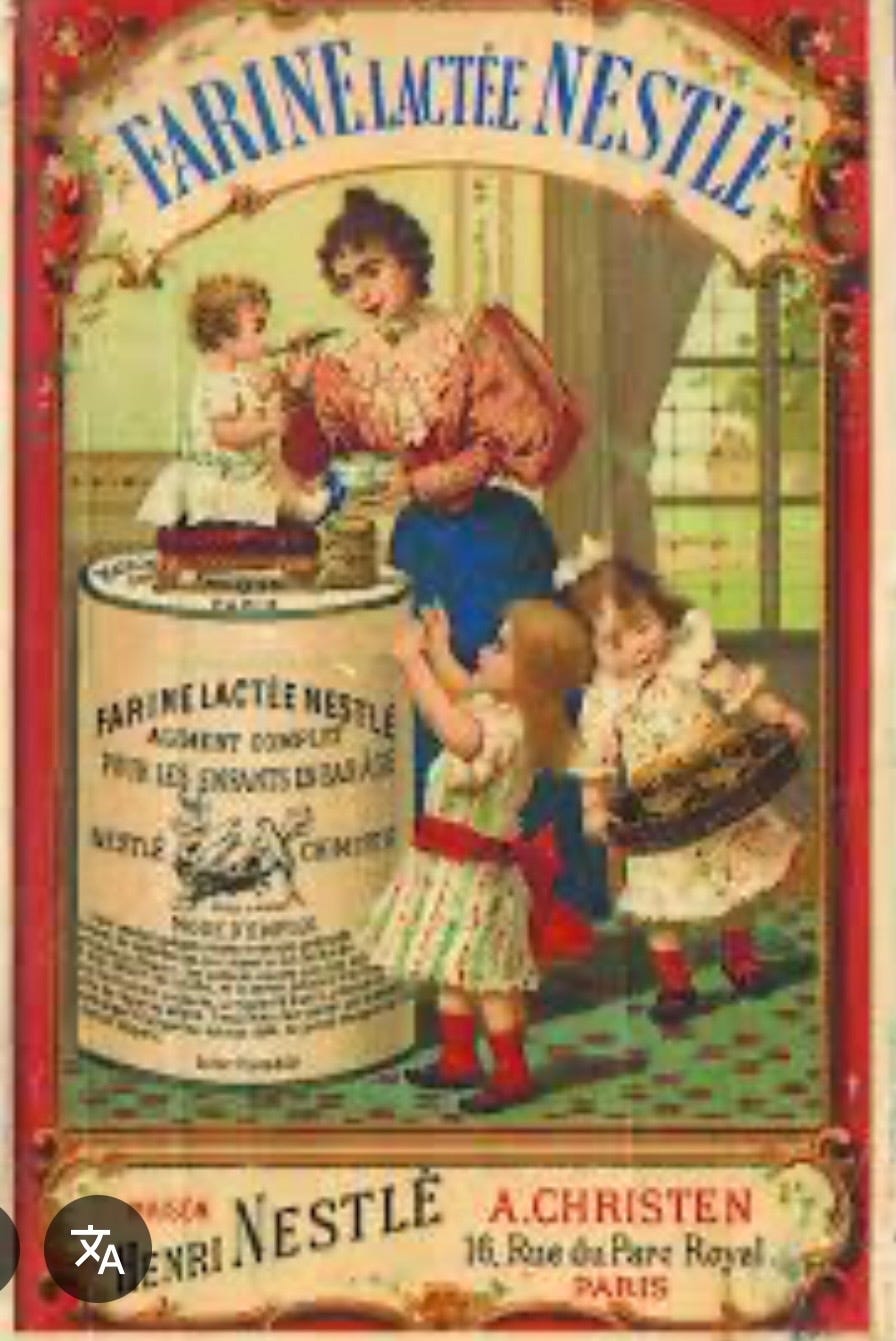
And then Henri Nestlé arrived in 1867 and did with chemistry what the Church had done with theology: enclosed the commons, sold back a simplified version, and called it progress.
The industrial enclosure could not have succeeded without the theological enclosure. Nestlé did not have to convince mothers that their bodies were inadequate. Fifteen centuries of Christianity — built on millennia of prior scaffolding — had already done that work. The formula company did not create the distrust. It monetized it.
Every fermentation chain has an origin. I said in “Mother’s Milk” that the origin is the mother’s body. That is still true. But the enclosure of that origin — the project of capturing the maternal body and making its meaning, its substance, and its labor the property of institutions controlled by people who will never lactate — that origin is older than any single religion. It is civilizational. It runs through every empire, every temple, every cathedral, every factory, every boardroom. The enclosure is the chain. And the mother’s body is what it has been trying to contain since the beginning.
IX. Testimony
I was baptized Catholic. That was the first claim the institution made on my body — before I could speak, before I could consent, before I had any say in the matter. Water on the forehead, original sin washed away, and the child now belongs to the Church. That is the template. The institution touches the body first and explains later, if it explains at all.
After that came weekly Mass. Then Mt. Merici Academy in Waterville, Maine — private Catholic school, where the institution didn’t just touch you on Sundays but held you five days a week, structured your time, shaped your language, told you what was sacred and what was sin. Then catechism, the formal instruction — the curriculum of obedience dressed as theology. I learned the sacraments. I received communion. I went to confession. I sat under images of the Virgin Mary for the entire arc of my childhood and never once thought about what those images were doing.
In sixth grade, the school told me I was not “mature” enough to move on to junior high.
I want to sit with that word. Mature. The same institution that had baptized me before I could talk, that had required my obedience before I could reason, that had fed me a theology of submission and called it grace — that institution now claimed the authority to assess my maturity. To hold me back. To mark me, in front of every kid I knew, as not ready. Not enough.
The game changer that was doesn’t even begin to describe it. From that point on, I was othered. Not in the abstract, theoretical sense. In the hallway sense. In the lunchroom sense. In the way that every kid who stayed behind knows — the looks, the silence where your name used to be, the slow realization that the institution has stamped something on you that you did not choose and cannot wash off. The Church enclosed my body at baptism. It enclosed my mind through catechism. And then it enclosed my social existence by declaring me deficient on its own terms.
This is what institutions of control do. They set the criteria. They perform the assessment. They deliver the verdict. And if the verdict damages you, that is your problem, not theirs. The child is not mature enough. The milk is not pure enough. The mother is not virgin enough. It is always the same diagnostic, applied to different bodies.
My mother, Ann Marie, breastfed me. She told me this once, the way mothers of her generation told you things — briefly, without elaboration, as a fact that did not require discussion. I don’t know for how long. I don’t know the details. I know that she did it, that it was not something she talked about in public, and that the Church she attended every Sunday had spent the better part of two millennia making sure that what her body did — what every mother’s body does — was simultaneously sanctified and silenced.
She sat in a pew under a statue of a woman whose milk was a relic in churches she would never visit, whose breast had been painted by men who had never nursed a child, whose body had been declared holy precisely because it had been declared empty of everything that made Ann Marie’s body her own. And then she went home and fed her children from her body.
I don’t think she thought of it as resistance. She didn’t have that language. But it was.
Every mother who breastfeeds is performing an act that four thousand years of institutional power have been trying to capture — and that two centuries of industrial capital have been trying to replace. The body persists. The milk persists. The commons, no matter how many times it is enclosed, keeps producing.
That is fermentation. That is what a starter culture does. It survives the conditions that should have killed it, and it makes the next batch possible.
Bibliography
Ancient Egypt — Sacred Milk and Divine Nursing
Robins, G. (1993). Women in Ancient Egypt. Harvard University Press. On Isis, Hathor, and the iconography of divine nursing.
Pinch, G. (2002). Egyptian Mythology: A Guide to the Gods, Goddesses, and Traditions of Ancient Egypt. Oxford University Press.
Ebers Papyrus (c. 1550 BCE). Prescriptions involving breast milk as a medical substance. Translation references in Nunn, J.F. (1996). Ancient Egyptian Medicine. University of Oklahoma Press.
Graves-Brown, C. (2010). Dancing for Hathor: Women in Ancient Egypt. Continuum. On Hathor as wet nurse to the pharaoh and the theological function of divine lactation.
Levitical Purity Law & The Postpartum Body
Leviticus 12:1–8. Purification after childbirth.
Fonrobert, C.E. (2000). Menstrual Purity: Rabbinic and Christian Reconstructions of Biblical Gender. Stanford University Press. On the continuity between Levitical body management and Christian practice.
Cohen, S.J.D. (1991). Menstruants and the sacred in Judaism and Christianity. In S.B. Pomeroy (Ed.), Women’s History and Ancient History. University of North Carolina Press.
Greek Philosophy & The Subordination of the Maternal Body
Aristotle. Generation of Animals. Books I–II. The mother as passive matter, the father as active form. Breast milk as “concocted blood.”
Dean-Jones, L. (1994). Women’s Bodies in Classical Greek Science. Clarendon Press.
Soranus of Ephesus. Gynecology (c. 2nd century CE). Trans. O. Temkin (1956). Johns Hopkins University Press. Criteria for wet nurse selection, recommendations against colostrum.
King, H. (1998). Hippocrates’ Woman: Reading the Female Body in Ancient Greece. Routledge.
Rome — Wet Nursing and Extraction
Code of Hammurabi (c. 1754 BCE). Provisions regulating wet nurse contracts, including penalties for infant substitution.
Dixon, S. (1988). The Roman Mother. University of Oklahoma Press. On wet nursing as elite practice and the labor of enslaved and lower-class women.
Bradley, K.R. (1986). Wet-nursing at Rome: A study in social relations. In B. Rawson (Ed.), The Family in Ancient Rome. Cornell University Press.
Garnsey, P. (1999). Food and Society in Classical Antiquity. Cambridge University Press. On the political economy of food and nourishment in the Roman world.
Christianity — The Totalizing Synthesis
The Madonna Lactans & Iconographic Inheritance
Miles, M.R. (2008). A Complex Delight: The Secularization of the Breast, 1350–1750. University of California Press.
Yalom, M. (1997). A History of the Breast. Alfred A. Knopf. Chapters 2–4.
Holmes, M. (2009). The Miraculous Image in Renaissance Florence. Yale University Press. On the suppression of the Madonna Lactans after Trent.
Catacomb of Priscilla, Rome — earliest known image of the Madonna Lactans, c. 2nd–3rd century.
Benko, S. (2004). The Virgin Goddess: Studies in the Pagan and Christian Roots of Mariology. Brill. On the Isis-to-Mary iconographic continuity.
The Virgin’s Milk as Relic
Calvin, J. (1543). Treatise on Relics (Traité des reliques).
Geary, P.J. (1978). Furta Sacra: Thefts of Relics in the Central Middle Ages. Princeton University Press.
The Council of Trent & The Suppression of the Breast
Canons and Decrees of the Council of Trent, Session XXV (1563): “On the Invocation, Veneration, and Relics of Saints, and on Sacred Images.”
Steinberg, L. (1983). The Sexuality of Christ in Renaissance Art and in Modern Oblivion. Pantheon/October Books.
Churching of Women
Cressy, D. (1993). Purification, thanksgiving, and the churching of women in post-Reformation England. Past and Present, 141(1), 106–146.
French, K.L. (2008). The Good Women of the Parish: Gender and Religion After the Black Death. University of Pennsylvania Press.
Colostrum Rejection — Cross-Cultural Evidence
Fildes, V. (1986). Breasts, Bottles, and Babies: A History of Infant Feeding. Edinburgh University Press.
Wickes, I.G. (1953). A history of infant feeding. Archives of Disease in Childhood, 28(138–141).
Obermeyer, C.M. & Castle, S. (1997). Back to nature? Historical and cross-cultural perspectives on barriers to optimal breastfeeding. Medical Anthropology, 17(1), 39–63.
Laroia, N. & Sharma, D. (2006). The religious and cultural bases for breastfeeding practices among the Hindus. Breastfeeding Medicine, 1(2), 94–98. On non-Christian colostrum rejection practices for comparative context.
Wet Nursing as Extraction Economy
Fildes, V. (1988). Wet Nursing: A History from Antiquity to the Present. Basil Blackwell.
Sussman, G.D. (1982). Selling Mothers’ Milk: The Wet-Nursing Business in France, 1715–1914. University of Illinois Press.
Kertzer, D.I. (1993). Sacrificed for Honor: Italian Infant Abandonment and the Politics of Reproductive Control. Beacon Press. Mortality in Church-run foundling hospitals.
Theological Framework
Bynum, C.W. (1987). Holy Feast and Holy Fast: The Religious Significance of Food to Medieval Women. University of California Press.
Warner, M. (1976). Alone of All Her Sex: The Myth and the Cult of the Virgin Mary. Alfred A. Knopf.
Federici, S. (2004). Caliban and the Witch: Women, the Body and Primitive Accumulation. Autonomedia.
Aquinas, T. Summa Theologica, I, q. 92. On the female as “defective and misbegotten” — the Aristotelian inheritance in Christian doctrine.
Anecdotal & Personal References
Sean Doherty — baptized Catholic, raised in weekly Mass attendance, educated at Mt. Merici Academy (Waterville, Maine) and catechism classes. Held back in sixth grade by the institution that had claimed authority over his body and mind since infancy. The entire framework of Marian devotion, institutional assessment, and the politics of “maturity” as lived experience, not academic study.
Ann Marie Doherty (1938–2025) — the author’s mother. Breastfed her children, attended Mass, sat under the image of the Virgin, and never once confused the institution’s version of motherhood with her own.
This addendum is part of “Mother’s Milk,” the first post from The Starter Culture. The original essay traces the biochemistry of umami in breast milk through the industrial enclosure by Nestlé in 1867. This addendum extends the timeline backward — four thousand years backward — to trace the full chain of capture: from the sacred milk of Isis, through Levitical purity law, Greek philosophy, Roman extraction, and the Christian synthesis, to the factory floor. The enclosure of the maternal body is not a modern event. It is the longest-running operation in the history of institutional power.